Buying a duplex or townhome in North Topsail Beach can look simple on paper, but this is not a market where broad averages tell the whole story. Inventory is limited, price points vary widely, and factors like flood exposure, insurance structure, and exact beach access can change the investment picture fast. If you are weighing a rental-ready purchase here, understanding the details can help you avoid expensive surprises and make a more confident decision. Let’s dive in.
Why North Topsail Beach Stands Out
North Topsail Beach is a thin coastal market, which means each property deserves close, address-level review. According to Redfin’s North Topsail Beach housing market data, the median sale price was $737,500 in February 2026, with a median sale price per square foot of $395 and an average of 76 days on market.
That broad snapshot is helpful, but duplex and townhome investors need to go deeper. The same Redfin data shows only 45 townhouses listed at a median listing price of $585,000 and just 3 multi-family properties listed at a median of $1.2 million. In a market this small, you cannot rely on town-wide averages alone.
Compare By Property Type
Townhomes and duplex-style properties can both appeal to investors, but they usually serve slightly different strategies. A townhome may offer a lower entry point and simpler upkeep, while a duplex or multi-family property can create more flexibility through multiple rentable spaces.
Current public inventory shows just how wide the range can be. Redfin’s townhouse listings for North Topsail Beach include units from roughly $399,000 for a 3-bedroom, 2-bath property to about $1.15 million for larger Villas Drive townhomes. Multi-family listings range from about $725,000 for a 4-bedroom duplex to $1.67 million for a six-unit ocean-view property.
That spread matters because a lower-priced townhome and a larger duplex may not compete for the same guest, budget, or use case. You should compare properties by:
- Exact location
- Bedroom count
- Guest capacity
- Oceanfront, second-row, or canal-front position
- Parking setup
- Elevator access
- Pool access
- Furnishing level
- Building age and elevation style
Rental Demand Looks Real, But Underwrite Carefully
North Topsail Beach has a well-established vacation rental market, but public data providers do not line up perfectly. On the demand side, Airbnb’s North Topsail Beach stays page shows 1,460 vacation rentals, 32,930 verified reviews, and a 4.8 average rating, which supports the idea that this is an active short-term rental destination.
The challenge is that revenue and occupancy estimates vary by source. AirROI’s North Topsail Beach report estimates about 944 active listings, 38.0% average occupancy, a $453 ADR, $187 RevPAR, and average annual host revenue of $43,744. Airbtics, as summarized in the research, estimates 955 active listings, 57% occupancy, $323 ADR, and $69,000 in median revenue.
When sources differ that much, the safest approach is to treat the numbers as directional rather than guaranteed. For underwriting, conservative assumptions usually make more sense than building a purchase around the highest projected income.
Larger Units May Fit The Market Better
Public rental mix suggests that bigger vacation properties often have an edge in North Topsail Beach. AirROI reports that 58.6% of listings have 3 or more bedrooms and 55.2% accommodate 8 or more guests, with an average stay of about 4.9 nights.
That pattern suggests duplexes and larger townhomes may attract family groups more easily when they offer enough sleeping capacity, parking, and convenient beach access. Smaller units can still work, but they may need sharper pricing and simpler operations to stay competitive.
If you are comparing two properties, guest experience matters almost as much as the view. A unit with easier access, better layout, and less operational friction may outperform a technically similar listing that feels harder to use.
Flood Risk Is Central To The Investment
In North Topsail Beach, flood exposure is not a side note. It is one of the main parts of the investment analysis.
The town’s CAMA land-use plan states that more than 97% of the town’s corporate limits are in a Special Flood Hazard Area. About 78.5% is in VE zones and 19.2% is in AE zones.
That matters because VE and AE areas do not carry the same risk profile. The town describes VE zones as high-wave coastal hazard areas, while AE zones are surge areas where wave action is reduced or absent. In practical terms, an oceanfront or exposed property may belong in a very different insurance and maintenance bucket than a sound-side or more sheltered address.
CBRA Can Change The Deal
Flood zones are only part of the coastal risk picture. You also need to screen for CBRA status before you get too far into due diligence.
According to North Topsail Beach’s Coastal Barrier Resources Act information page, CBRA affects about 56% of the town’s land mass. The town notes that properties within CBRA are ineligible for NFIP participation and certain forms of federal grants and aid.
That can have a major effect on insurance planning and long-term ownership costs. The same town page notes that CBRA boundaries are no longer shown on FIRMs after January 25, 2019, and that U.S. Fish and Wildlife Service maps are the authoritative boundary source. For investors, this means parcel-level verification is essential.
Insurance Should Be Split Into Two Questions
In many inland markets, buyers think of homeowners insurance as one line item. In North Topsail Beach, that approach is too simplistic.
The North Carolina Department of Insurance flood insurance guidance says standard homeowners policies do not cover flood damage and that flood insurance is separate, generally with a 30-day waiting period. The same guidance also notes that windstorm and hail coverage may be excluded from the main policy in coastal areas and may be written separately, sometimes through NCIUA, with separate deductibles and named-storm deductible rules.
That means you should quote:
- Flood insurance
- Wind and hail coverage
- The primary homeowners policy
- Deductible structures for all applicable policies
North Topsail Beach does offer some help here. The town’s Program for Public Information page says it provides flood-map help, elevation-certificate assistance, and site-visit advice. It also notes that the town’s CRS Class 5 rating gives a 25% annual discount on NFIP policies.
Building Age Matters More Near The Coast
For duplex and townhome investors, construction age is not just about aesthetics. It can affect insurance, maintenance, guest appeal, and future capital needs.
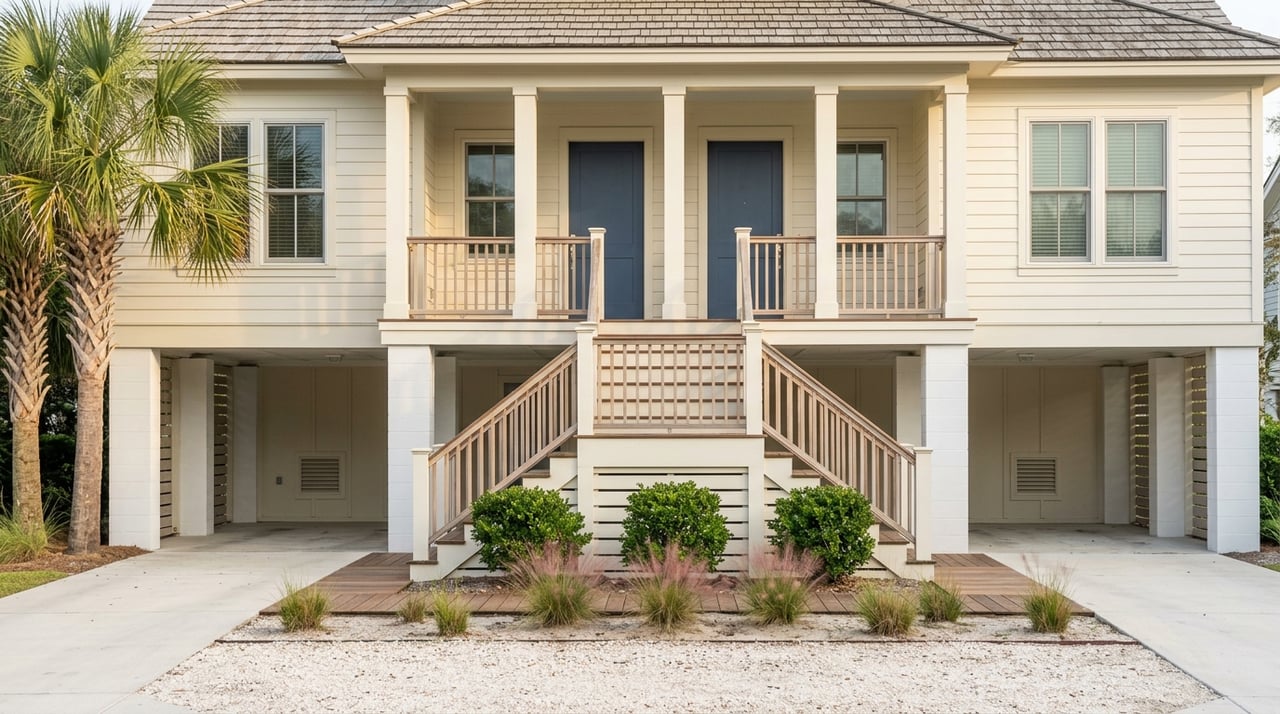
North Topsail Beach’s Building Inspections Department says residential permit applications must comply with the 2018 NC State Residential Code. Active inventory in the research shows meaningful differences in age and construction style, from a 1991 duplex on pilings to a 1999 townhome on pilings to a 2022 multi-family property with pilings and an elevator.
In general, newer elevated construction may support smoother operations and easier rental marketing, while older properties may offer a lower purchase price but carry more uncertainty around future updates and insurance costs. That does not make one category automatically better than the other, but it does mean your inspection and budgeting process should reflect the age of the structure.
Taxes And Occupancy Costs Affect Returns
Taxes can change the real investment picture faster than many buyers expect. According to Onslow County’s tax rate document, the county rate is 0.655 and the North Topsail Beach rate is 0.430, for a combined 1.085 per $100 of assessed value.
Using purchase price as a rough proxy, that equals about $6,347 per year on a $585,000 townhome and about $13,020 per year on a $1.2 million multi-family property. Onslow County also noted in December 2025 that it was in a 2026 revaluation cycle with a median increase of 37% since the 2022 revaluation, so future tax bills may move materially after reassessment.
Short-term rental taxes also belong in your underwriting. North Topsail Beach’s Realtors and Landlords page states that the town levies a 3% accommodation tax and Onslow County levies a 3% occupancy tax, with state and local sales tax also applying to rentals.
A Smart Due Diligence Process
If you are serious about duplex or townhome investment in North Topsail Beach, the best approach is highly specific and address-based. This is not a market where a simple cap-rate shortcut tells the whole story.
Before you write an offer, make sure you:
- Verify the exact flood zone
- Check CBRA status by parcel
- Request the elevation certificate
- Quote flood and wind/hail coverage before closing
- Review HOA dues and reserve strength
- Confirm rental rules and restrictions
- Compare only to public rental comps with matching bedroom count, guest capacity, and beach access profile
North Topsail Beach’s planning department flood information services can help with flood information, elevation certificates, and map amendment guidance, which makes this screening process more practical.
Bottom Line For Investors
A duplex or townhome in North Topsail Beach can make sense for the right buyer, especially if you want a coastal property that supports personal use, rental use, or a blend of both. The opportunity is real, but so is the need for disciplined underwriting, especially around flood exposure, insurance structure, taxes, and true rental comparables.
In a small beach market like this, the best investments are usually the ones that look strong not just on a listing sheet, but in a full, property-specific review. If you want local guidance on how to compare options, pressure-test the numbers, and navigate the details of a coastal purchase, connect with The Waller Team for concierge-level support tailored to your goals.
FAQs
What makes duplex investment in North Topsail Beach different from other markets?
- North Topsail Beach has limited inventory, a wide price spread, and major property-specific factors like flood zone, CBRA status, insurance structure, and beach access that can change the deal quickly.
Are townhomes in North Topsail Beach a lower-cost way to invest?
- They can be, since current public listings show townhomes at a lower median listing price than multi-family properties, but the real value depends on location, size, rental appeal, and ownership costs.
How important is flood insurance for North Topsail Beach investment property?
- It is essential, because standard homeowners insurance does not cover flood damage and most of North Topsail Beach falls within Special Flood Hazard Areas.
What is CBRA and why does it matter for North Topsail Beach buyers?
- CBRA refers to the Coastal Barrier Resources Act, and affected properties may be ineligible for NFIP participation and certain federal assistance, so parcel-level verification is important.
How should you estimate vacation rental income in North Topsail Beach?
- Use conservative assumptions, compare public data sources carefully, and match comps by bedroom count, guest capacity, location, access, and amenities instead of relying on broad market averages.
What taxes apply to short-term rentals in North Topsail Beach?
- Public sources in the research show a 3% North Topsail Beach accommodation tax, a 3% Onslow County occupancy tax, plus applicable state and local sales tax.